Iris Berger · 12 October 2026
Climate Patterns and Their Influence on Extract Quality in Plant-Derived Vitality Formulas
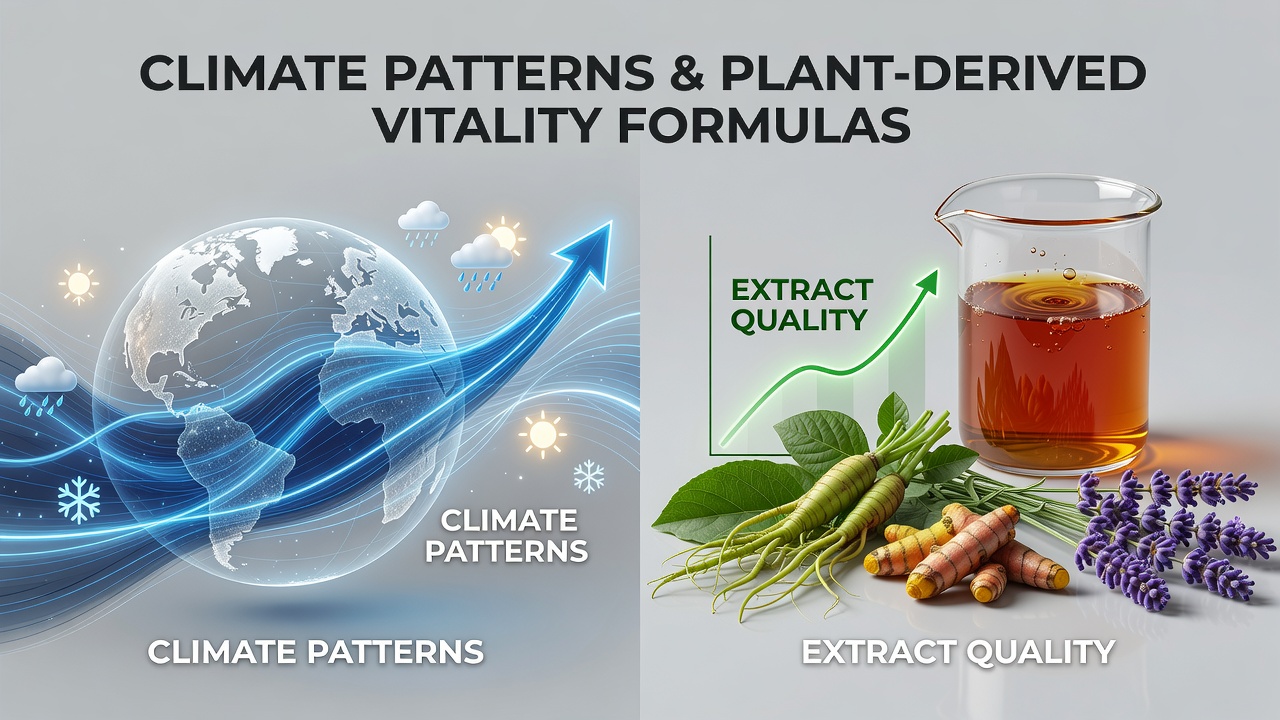
Shifts in global climate patterns have altered growing conditions for medicinal plants that supply bioactive compounds to vitality formulas, and researchers track these changes through long-term field studies that measure temperature fluctuations, precipitation variability, and atmospheric carbon dioxide concentrations across major production regions. Data from multiple continents indicate that rising average temperatures accelerate plant maturation cycles in some species while reducing the accumulation of secondary metabolites such as alkaloids, flavonoids, and terpenoids that contribute to extract potency.
Temperature and Precipitation Effects on Phytochemical Profiles
Extended heat waves during critical growth phases have prompted measurable declines in certain antioxidant compounds within roots and leaves of plants commonly used for daily wellness extracts, whereas irregular rainfall patterns create drought stress that can either concentrate or dilute target molecules depending on the species and soil type. Observers note that regions experiencing more frequent extreme weather events show greater year-to-year variability in harvest quality, which in turn affects standardization processes at extraction facilities. Studies conducted across temperate and subtropical zones reveal that plants subjected to prolonged dry spells followed by heavy rains often produce extracts with inconsistent levels of active ingredients compared with those grown under more stable moisture regimes.
Regional Variations Documented Through 2026 Monitoring Programs
Monitoring networks operating in October 2026 continue to record elevated nighttime temperatures in several high-altitude growing areas that traditionally supplied high-potency raw materials for plant-derived formulations, and these warmer nights correlate with reduced synthesis of certain stress-induced compounds valued in vitality products. In contrast, some lower-latitude zones have experienced cooler, wetter seasons that slow growth but preserve higher concentrations of phenolic compounds. Agricultural extension services in North America and Australia have published comparative datasets showing that extract manufacturers adjust sourcing strategies when regional climate anomalies persist beyond two consecutive growing seasons.
Carbon Dioxide Levels and Secondary Metabolite Production
Elevated atmospheric carbon dioxide concentrations stimulate photosynthesis in many medicinal species yet frequently lead to diluted nutrient density and lower concentrations of defensive phytochemicals, according to controlled environment experiments replicated across multiple research stations. Plants grown under elevated CO2 conditions often allocate more resources to structural carbohydrates at the expense of specialized metabolites, which directly influences the yield and consistency of concentrated extracts used in vitality formulas. Industry reports compiled by trade associations note that processors have begun incorporating climate-adjusted cultivation protocols to mitigate these shifts.

Supply chain analysts observe that sourcing from multiple climate zones helps stabilize extract specifications, and companies increasingly rely on predictive modeling that incorporates seasonal forecasts from meteorological agencies. One long-term study tracking ashwagandha and similar adaptogenic plants demonstrated that plots receiving supplemental irrigation during projected dry periods maintained steadier withanolide levels than rain-fed controls. Similar patterns appear in turmeric and ginseng cultivation records from Asia and North America, where temperature and moisture interactions determine both biomass and marker compound concentrations.
Adaptation Strategies in Cultivation and Processing
Cultivators have introduced shade structures, precision irrigation systems, and selective breeding programs to counteract climate-driven variability, while extraction facilities refine solvent ratios and temperature controls to compensate for incoming material differences. Government agricultural departments in Canada and the European Union have funded collaborative projects that map climate suitability zones for key medicinal crops through 2035, and preliminary results indicate that some traditional growing regions may require relocation or protected cultivation methods within the next decade. Data released by these agencies show measurable improvements in extract consistency when farms adopt microclimate management techniques.
Quality control laboratories apply near-infrared spectroscopy and high-performance liquid chromatography to verify bioactive levels in each batch, allowing manufacturers to blend lots or adjust formulations when climate-induced deviations occur. Trade publications document cases where suppliers who implemented real-time weather monitoring reduced batch rejection rates by significant margins compared with those relying solely on historical averages.
Conclusion
Climate patterns continue to reshape the production landscape for plant-derived vitality formulas through direct effects on plant physiology and indirect influences on agricultural practices. Ongoing research from institutions across multiple continents provides updated datasets that help extraction specialists maintain product specifications despite environmental variability. Those responsible for sourcing and processing track these developments closely because stable extract quality depends on understanding and responding to the interplay between weather trends and phytochemical synthesis.